What is a Guest User?
A guest user has limited authorisation rights and access to the Encodify platform to review content within online proofing and shall be granted time-limited access by invite only from an Internal or External user. The time-limited invitation link does not grant access to anything else within the Encodify platform.
How to configure Guest User Access
Important: Before configuring Guest User Access, an Encodify administrator must enable the relevant feature flag. If this setting is disabled, the section will remain hidden from the UI.
To enable the ability to invite guest users to review content within online proofing, follow the below steps:
Navigate to Site Configuration → Identity Providers and Users → Guest User
Locate the option Enable Guest User and ensure the checkbox is ticked
Enter the name of the associated Guest User Access Right. This will be automatically created once the configuration is saved.
In the Guest User Access section, tick the checkbox for each module where you want to allow guest user invitations. For each enabled module, specify which access rights should include permission to invite guests.
Click Save to apply the changes.
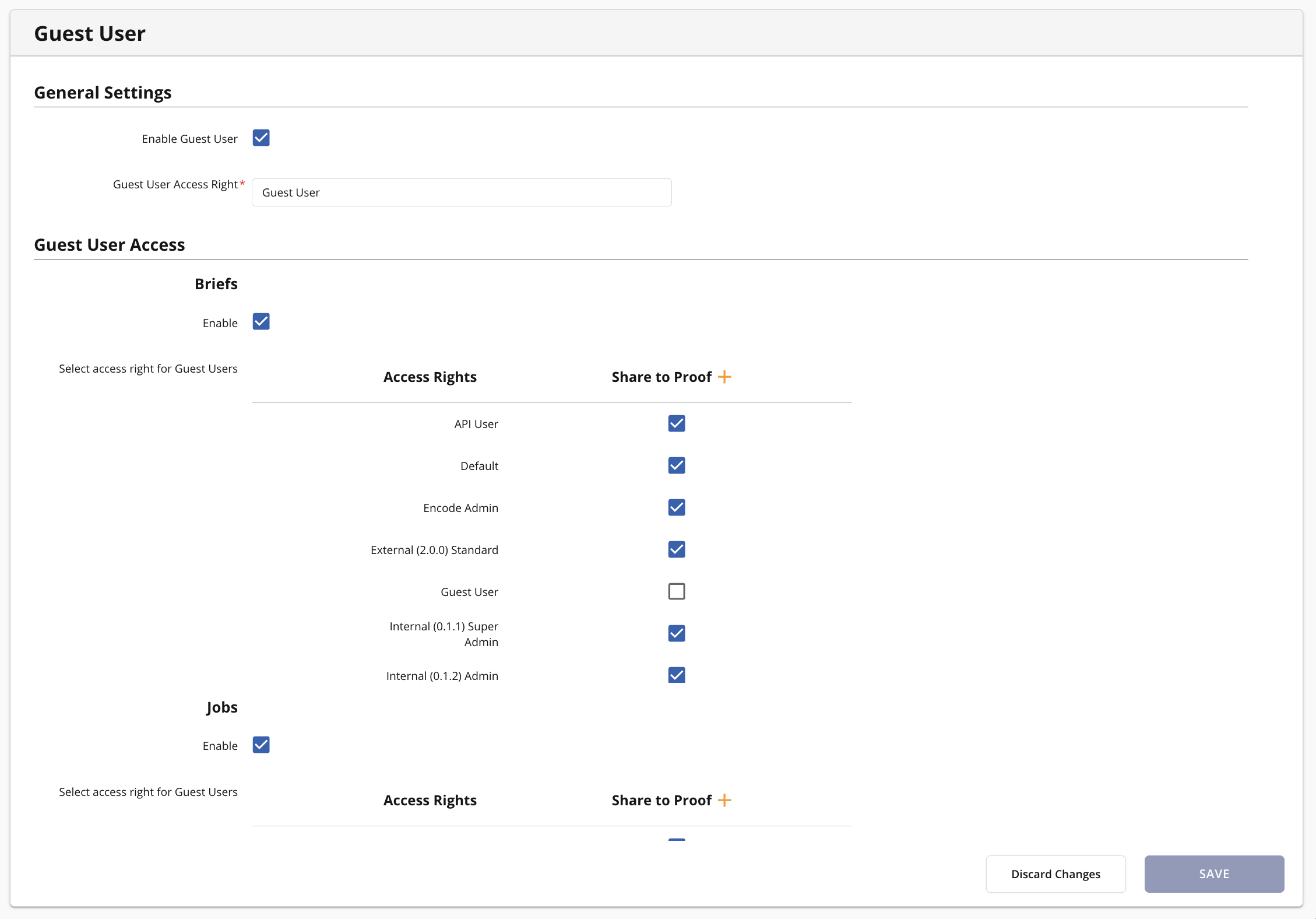
Settings for enabling guest user access
Guest User Notification Rule
Note: More details can be found within the article Notification Rules
After saving the guest user configuration, an Automation Rule will be created automatically for the enabled module(s) to notify guest users via email when they are invited as a shared recipient.
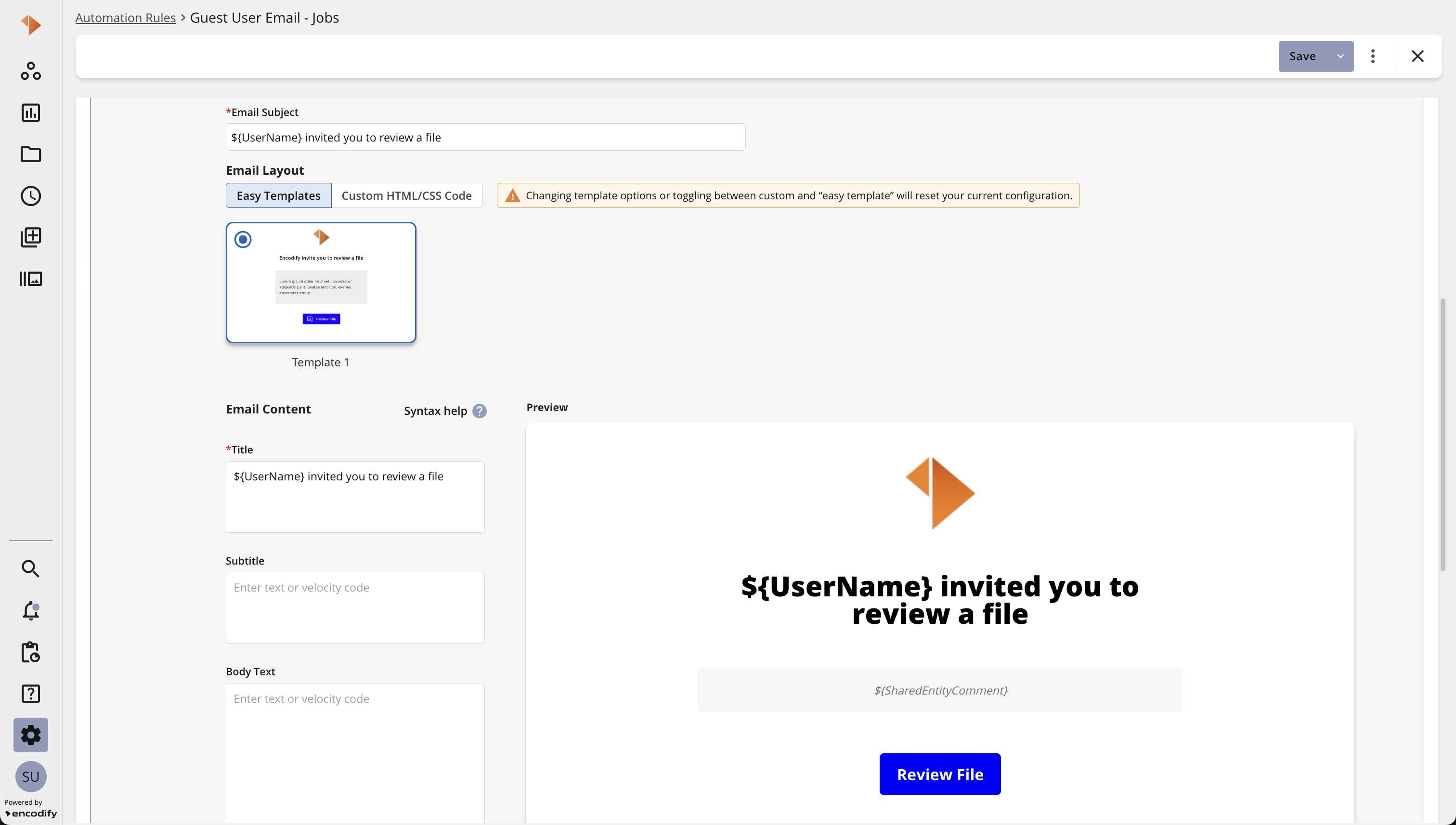
Email template preview for inviting a guest user
Note: Additional information regarding the configuration of Notification Rules can be found here.
Subscribing to Guest User Invitations
Note: More details can be found within the article Notification Rules
In addition to the Share Proofing Guest notification rule, it is also possible to configure a Share Proofing Subscriber notification rule. This allows specified internal users to be notified when an item is shared with a guest user. Notifications can be received through various channels, including the application, email, Slack, and Microsoft Teams.
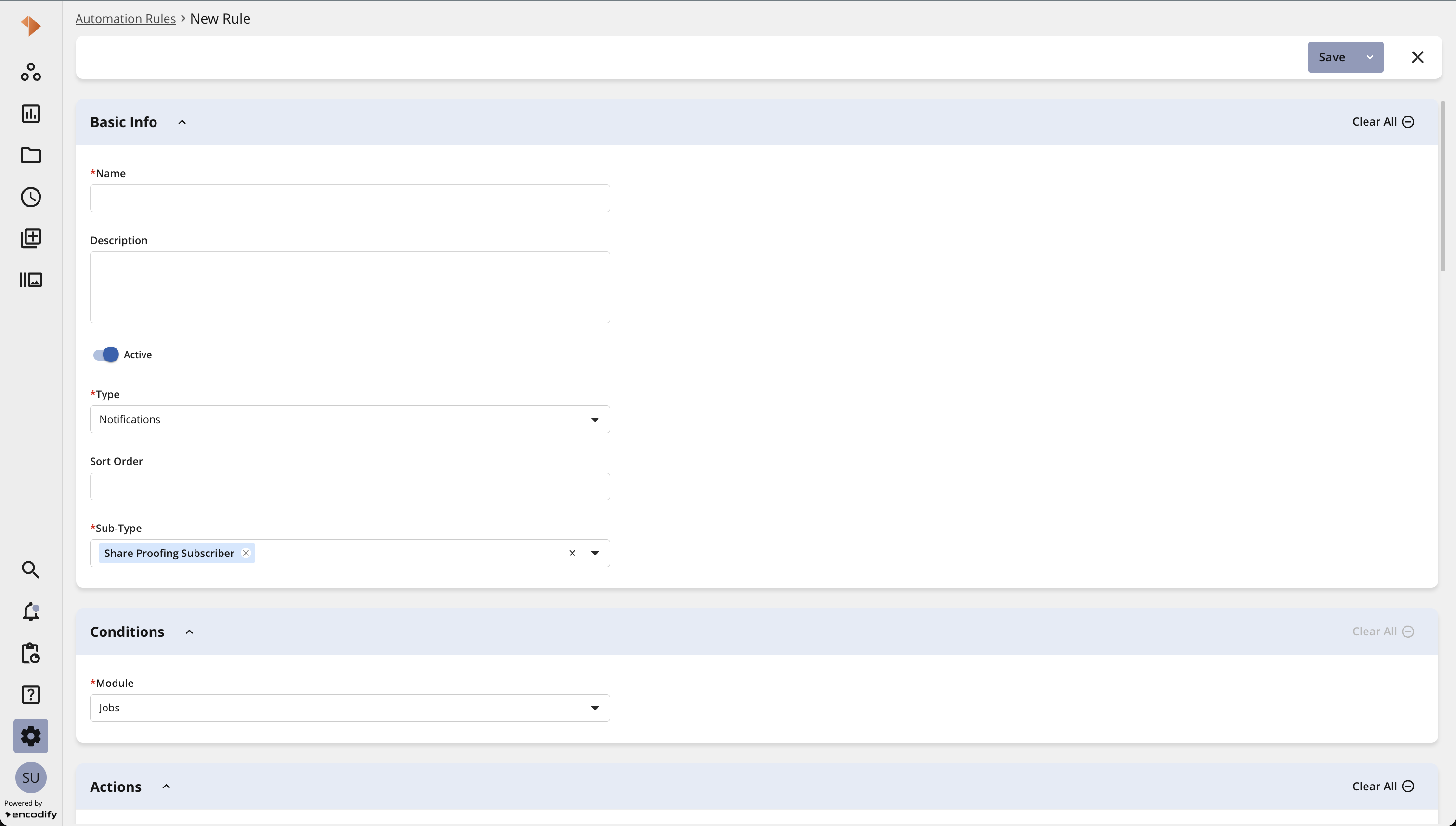
Automation rule of type share proofing subscriber
Extending Guest User Permissions
Group and status restrictions set for the item are ignored when granting guest users access to the shared item. Unreleased items will also be accessible to guest users. However, the following restrictions are still enforced:
Download access to the Proofing module
Download access to the Proofing Media Holder
Promotion settings
In addition to allowing guest users to add comments and annotations, it is also possible to extend their permissions to include:
Changing status, including adding comments and reasons (see the Change Status article for more details).
Modifying field data and uploading files during workflow transitions (see the Field Usage article for more details).
Guest User Permissions in Multi-file Proofing
Sharing is restricted to child items accessible to the initiating internal user.
When Group Restriction is enabled on the Proofing module, guest user access is limited to the child items included in the original sharing batch. This behavior is determined by the permissions of the internal user who initiates the sharing. When an internal user creates a sharing batch, they can only share child items to which they have access.
As a result, only those permitted item IDs are included in the multi-file sharing. Guest users receiving the shared link will have access exclusively to these child items.
Known Behaviour:
Before version 24, we do not support the possibility for guest users to participate within proofing review functionality.
If the group selection mode for users is set to Assigned by action and actions are configured, the groups assigned through those actions will override the app groups for guest users. To prevent this, it is recommended to use filters to ensure that group actions intended for internal users are not applied to guest users.
If restriction by status is enabled and a status field has a preselected value, the user sharing the item must be granted Create access by status.
Request to Review: Review permission persists across subsequent shares for the same guest user once enabled. Once ‘Request to Review’ permission is granted, it persists across all subsequent shares sent to the same guest user - even if the toggle is disabled in later invitations - allowing them to continue reviewing the proofing child items.
If a user has overlapping access (i.e. a proofing item is shared with the same user via both single-file proofing and multi-file proofing), revoking one share does not terminate the other.
create access to Review module should be granted to a user sharing the item(s).
It is possible to share a proof that expires today, if expiration time is set before the current time.
Access expiration timestamp is updated once a day for shared links.
Single-file Proofing: It’s important to note that only one active share link can exist for a unique email address per item. If you need to reshare an item with the same email address, it can be done from the Inactive tab as specified above.
Multi-file Proofing: It is possible to share Multi-file Proofing with the same guest user multiple times. In these cases, a new Guest Link is generated for each share. All generated links are managed separately in the Manage Guest Access screen.
It is also possible to share the same items multiple times with the same guest user via Guest Link. However, sharing the same item multiple times with the same guest user is not supported via email.
Share Logs: For proofing items shared via multi-file proofing, share information is available only in the multi-file proofing share window. The share log opened from the single item view will be empty and vice versa.